Moy Chuong and Dana Heng: From Garden to Grocery to Gallery, It’s Better with Friends
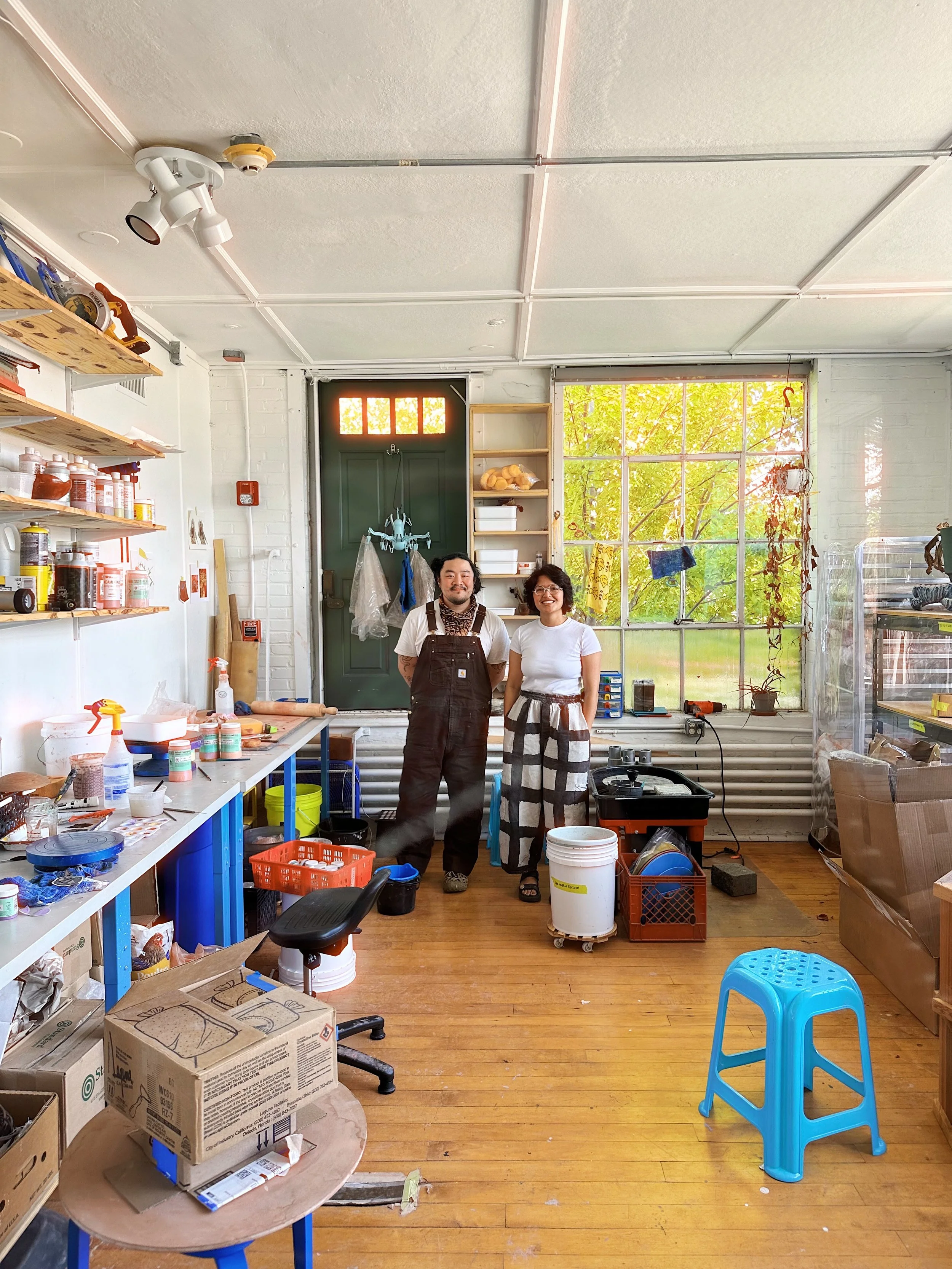
Growing up, the movement of food mattered to artists Moy Chuong and Dana Heng. They learned to steward different points of the agricultural cycle from their families. Although they didn’t know it yet, nor did they know each other, by 2024, these seeds would lead to their friendship—the foundation of their collaboration as Artists-in-Residence at Public Street for the Providence Commemoration Lab.
In the suburbs of New Jersey, Chuong spent the first fourteen years walking home from school with their grandmother, a Chinese and Cambodian immigrant. Over the years, she taught Chuong how to garden and cook, often pairing homegrown vegetables and herbs with ingredients she procured during trips to an Asian grocery store in Philadelphia. "My grandma used to make air-dry clay from the leftover dough when we would make bao and taught me how to sculpt birds,” they recall of these years.
Meanwhile, as a young teenager on the South Side of Providence, Dana Heng supported her family at their Asian grocery store on Public Street and Elmwood Avenue. Her parents named the business New Battambang Market after the Cambodian city from which they departed. In fact, Heng’s mother was pregnant with her on the plane ride over to New England. By 2008, they sold the market to a Laotian family, and now in 2025, it’s under the ownership of a new family who has renamed it Elmwood Market.
“When my parents had New Battambang Market, on the second floor was the storage area. That was where I would go after school. I would either hang out in the cash register area or go upstairs to do my homework,” remembers Heng of her parents’ former grocery store on Public Street and Elmwood Avenue. “It would be piles and piles of boxes, kind of like a little fort. The memory of it is imprinted. It's almost passive.”
⬒ ◧ ◫ ◨ ⬓
In early October 2025, I met with the duo in a studio they share with three other friends. It’s been a year since I first met with the pair. The month prior, the final Queer/Trans Zine Fest (QTZ) in Providence had concluded on the organizers’ terms after an electrifying 8-year run. Chuong and Heng had co-organized the zine fair with many of their friends. My handwritten notes from this first meeting include distillations like: “do it w/ other ppl,” “hang out w/ friends,” and “hard to do it alone."
Throughout our year together, Heng, Chuong, and I always met over food. As the Writer-in-Residence on Public Street for the Providence Commemoration Lab, I was tasked with documenting the Artists-in-Residence’s process. It occurred to me that this two-hour interview near the end of our time in the Lab is the first time we’re meeting without eating together.
A week prior, the pair gifted two hefty ceramic planters shaped like produce boxes to Chef Bree Smith at the weekly Sunday Soup event Smith runs at the Southside Cultural Center. Plant illustrations, including calendula, lemon balm, tulsi, and plantain, were applied with underglaze to the sides of the boxes. One request from Smith was to illustrate the slogan, “Herbs to heal a nation.” At the end of Sunday Soup, Smith remarked how much it mattered that she had another useful tool to feed her family and her community.
Smith’s own expertise in gardening and cooking came from her late grandmother, the activist Ms. Mattie L. Smith — it was around her kitchen table that the organization Direct Action For Rights And Quality (DARE) was founded. Now, Heng and Chuong were preparing to gift a cedar public planter to the Mattie Smith Tot Lot, one of the lots she cleaned up to ensure young children had a safe place to play outside in the neighborhood.
Heng and Chuong first met Chef Bree Smith at a seed starting event they hosted at the Rosa Parks Resource Center in May 2024. Fittingly, the friendship between the three bloomed from one seed planted at the event. Over months, the three met over meals to identify how best to design and deliver the planters. Heng says, “When you're well-fed, people are maybe willing to let down their guards a little easier and, as Bree says, build fellowship.”
⬒ ◧ ◫ ◨ ⬓
In 2016, Chuong and Heng met. Although they can’t recall exactly how, they became fast friends. Chuong was about to start a Master’s in Industrial Design. They took classes at the Steel Yard, which offered a necessary reprieve from the toll of their work as a psychiatric research assistant. To pay the bills, they conducted assessments at Butler Hospital with queer youth expressing suicidality. They also led interviews with people incarcerated at the Adult Correctional Institutions operated by the Rhode Island Department of Corrections.
In 2016, Heng was returning home a year after graduating from college in Vermont. This is where she first learned to cook to access Asian food while living in communal spaces. Heng tells me that she has remained “connected to produce” even after she herself “grew out” of grocery stores. Her extended family still owns grocery stores in Providence, including Sunny Market and Pacific Seafood Market on Reservoir Ave. She recalls of her uncle, who owns Sky Market on Cranston St: “He bought me a bike for high school graduation so I had something for college. Then when he heard I was going to be in Burlington, he said, ‘Shop at Thai Phat,” because that store bought wholesale from our family.”
Their early collaborations involved creating props to accompany parties and dinners parties. The first creation may have either been either a “concept birthday party” called “Seltzies” or an ice floe-themed dance party, Chuong discloses to me. One infamous endeavor included Pizza Week, a competitive bake-off between teams of duos—the second of which was hosted at Dirt Palace when Heng was a resident. She says, “There were four judges who judged based on ‘presentation and how much it reminded them of a pizza.’” The point, of course, is having fun.
⬒ ◧ ◫ ◨ ⬓
To promote Heng and Chuong’s largest collaboration, New Battambang Market, an exhibition at the Providence Public Library, the private institution wrote in a 2022 newsletter, “If you found yourself poking around on PPL’s third floor recently, you may have noticed the boxes filling the Joan T. Boghossian Gallery.” The official description described the pair recreating scenes of Heng’s family’s former grocery store: “familiar and mundane objects, from corporate calendars once found in the market to vibrantly colored plastic stools” created with “ceramic sculpture, screen printing, and installation.” This is how I first learned about the duo.
The repetition of food motifs reminds me of what is “imprinted,” as Heng describes, until it’s unescapable. When Chuong walked me through the ceramics process, it came up again: “You’re making sure that you're rolling in different directions because that tension gets stored up even in the piece because clay has a memory for the most part. And so if you're building, for example, a box, some of that tension—if it hasn't already been resolved in the building of the piece—it might come out in the kiln and result in a crack.”
At the center of one contemporary discursive rupture in Asian American art and culture is food, and by extension, foodways (meaning: the social, cultural, and economic practices of how we produce and consume food). Consider the memeification of “mango poetry,” “stinky lunchbox narratives,” and the potential affective excess behind what Chuong describes the “context of grandma art within diaspora.”
As Asian American artists, why make “food art” in 2025? After some back-and-forth between the pair, Heng responds. “We all have to eat. I guess this relates to the whole philosophy behind even our Commemoration Lab project or in the way that we make art about memory or the mundane,” she says, her clarity piercing. “If you're thinking about it politically, food is resistance. It is self-determination. We can grow the things we want to grow. We'll cook for each other. This is how we care for each other. It’s how we can relate to each other in an ancestral way, connecting to how the people before us have.”
⬒ ◧ ◫ ◨ ⬓
Returning to the scope and memories of the Lab, I asked, “Why did you move your knowledge of ceramics into planters?”
“Working with my grandmother, I just remembered doing a lot of growing and planting, and there is a time where I moved away from that in the very practical sense of like not actually doing the farming or gardening. As an adult. that's re-entered my life. I think this happens for a lot of people and it has like happened in like our conversation with Bree [Smith],” Chuong remembered. Heng echoed this return in her adulthood, “When the pandemic happened, that's when I really got into gardening with my grandma. She would use old broomsticks and random plastic strings to build trellises together,” Heng reflected.
“I feel like that's something that I've returned to. It felt very natural. I was already like making ceramic sculpture. It made a lot of sense to then tie those things together,” Chuong furthered. Heng responded, “We were thinking of community gardens and our experiences coming from the diaspora—second-generation, first-generation immigrants—and our resilience in self-sustaining gardening practices, and doing that with what you have access to. If you don't have land, you have a bucket that you can put dirt in.”
“The object could have been a plastic planter,” Chuong followed. “From a larger cultural standpoint, there's so much negative connotation about plastic and its existence. Even when you think about like, actually plastic is going to be a really long lasting artifact when it comes down to it.” They note how even ceramic "is just dirt" but the “laborious process [...] gives it some weight as a commemorative medium to work within.”
⬒ ◧ ◫ ◨ ⬓
At the end of our two hours, I asked, “Could you describe the other to someone who doesn't know the other at all?”
“Oh, my God, we have to do this in front of each other. How embarrassing. I'm just kidding. Um, how do I describe Moy?” Heng begins, pacing herself carefully. “Moy’s my friend. They make ceramics. How do I describe you? Very fashionable. Loves dogs and animals. All animals. If Moy is interested in something and learning how to do something, they get really hyper-focused and go all the way and obsess over something and get really, really good at it, like knitting.”
Chuong follows, “Dana's my friend. She is an artist and youth worker. The thing that comes to mind the most is how generous of an individual Dana is, especially. I don't know if she would say this, but I think that she loves to host and is a great host. I feel like she's always having dinner with someone or someone’s coming over for dinner. When she's like, ‘Oh, I just got some fresh fish. Let's have ceviche.’ Always happy to share those things. If I want a different perspective, it's always good to go to Dana. I think you just have a different way of thinking about things than I do at times, or a different way of approaching a question. And I think that's helpful.”