Eli Nixon: Practical Spectaculah at the Public Street Right-of-Way to the Bay
With a sign reading “No LNG in PVD,” artist Eli Nixon approaches the microphone at a RI Coastal Resources Management Council (CRMC) meeting in May 2017. “I'm here on behalf of my father, who was a scientist and oceanographer out of URI who served on CRMC's Scientific Advisory Board on multiple projects related to the Narragansett Bay. His name was Scott Nixon,” they testify. “I'm also here on behalf of my own kid, who lives in Pawtucket with me. I wanted to call on both of them from the past and the future against the proposal of this project and your mandate to protect the resources around Narragansett Bay.”
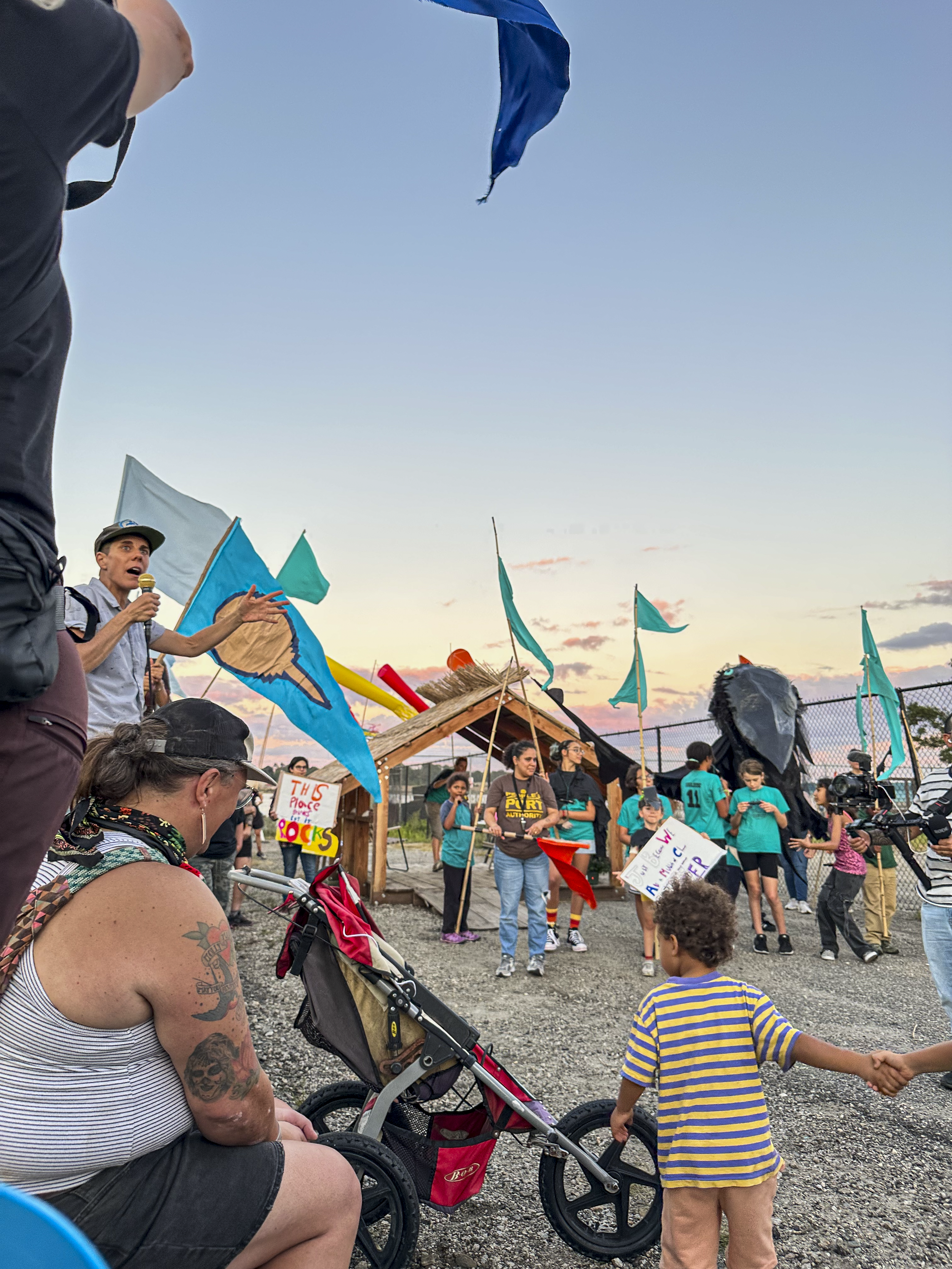
In an October 2018 headline, The Providence Journal reports federal regulators “approve construction of the $180-million natural gas processing plant proposed by National Grid on the Fields Point waterfront,” but the No LNG in PVD movement never ceases. Instead, the community group led by residents of Washington Park and South Providence becomes the People’s Port Authority (PPA). The organization’s mission: “to educate, mobilize, and support our community members that are directly impacted by environmental racism.” Seven years from now, Nixon and the PPA will convene upwards of 140 people for Crows Landing, Nixon’s second-to-last public celebration at the Public Street coastal right-of-way for the Providence Commemoration Lab (PCL).
In matters of climate, not only do the consequences of the present shape the future, it’s critical to attend to the minutiae of the past. I learn similar lessons from my father-in-law, Stephen Olsen, the former Director of the URI Coastal Resources Center, whose papers I thumb through when I encounter the name of his colleague: Dr. Scott Nixon.
Grief offers perpetual shade, one definition of which, is “a lingering image of something passing away.” With documentation, one’s livelihood rarely disappears in full. In a recording from beloved journalist Steve Ahlquist, I watch expressions in the background pivot as Nixon addresses their late father in the past tense. In a House Resolution after his passing, I find details corroborating Dr. Nixon’s decorated biography. And because of the Access to Public Records Act (APRA), I find his adult child, Eli Nixon, misrepresented in the CRMC’s public minutes. However, Nixon is “retroactively not worried about it.” They’re here to keep the record askew.
▭ ▭ ▭ ▭
Almost a year after our first meeting for PCL, I met with Nixon in person for a culminating two-hour interview. Today, I was running behind to meet them because of Judge Frank Caprio’s motorcade. We’re under a covered porch as it rains. For an intervention situated by access to water, it’s fitting the morning sky is full of it. While I understand that maybe there are no straight answers to be found here, I knew I would encounter spectaculah, a whimsy bold enough to envision more—future meeting past, and then some.
In September 2024, I first met with Nixon by video to learn about their PCL project as Artist-in-Residence on Public Street. We had certainly crossed paths before, as queer Rhode Islanders do. I knew they created puppets, theater, cardboard constructions, and Bloodtide, described as “a new holiday in homage to 450 million years of horseshoe crab fortitude.” However, we’d never spoken one-on-one. I have no written records of this meeting, only an event saved in my calendar and my memories of overwhelm at the scale of their planned project. I also perceived a skepticism about creating art for The City of Providence—Nixon would later contextualize this as the “irony” of deploying “art to meet public health needs”. I wondered if any wariness was aimed at the obligation to meet with me, a Writer-in-Residence on Public Street charged with documenting each Artist-in-Residence’s process.
What I read as their question around my role around me wanes at the beginning of December 2024 at a RI Department of Environmental Management (RIDEM) meeting for a Public Involvement Plan (PIP) following two scrapyard fires at Rhode Island Recycled Metals (RIRM) along the Port of Providence. At the tedious meeting’s conclusion, Nixon noted to me that the news channel WPRI 12 interviewed the attorney for RIRM, but not the community members in attendance. Nixon and I both ended up heckling the journalists to their faces. Getting messy felt appropriate. After all, this was about where Public Street meets Allens Ave.
▭ ▭ ▭ ▭
Nixon planned to thatch a shade structure at the Public Street right-of-way, an area fully exposed to the elements. “I got a lot of reinforcement for ideas centering practical improvements to the site,” they shared about community feedback to their PCL project. Design and fabrication were led by Fatema Maswood, Wes Sanders, and Yasmine Hassan. Maswood first brought Nixon to Public Street in 2020. The thatched shade structure was fabricated using local bamboo harvested after hours from an elephant enclosure at Roger Williams Park Zoo. The wood was from a sawmill in Coventry that was sold as “tamarack” but leaked sap like pine. Weaver Aymar Ccopacotty taught Nixon's team to thatch the roof out of phragmites (local coastal reeds) gathered by a couple rounds of Nixon’s friends after snow pushed the initial December 2024 harvest back to March 2025.
During a casual July 2025 stop to the Public Street waterfront, I encountered the floor and frame of Nixon’s shade structure and a handwritten in-progress sign. Days later as a summer heatwave approached, I brought beverages to Nixon, Maswood, Ccopacatty, and Tycho Horan. Since their time, they had gathered “gossip” from Pete’s Tire Barns, and had been “sprayed with rust mist” from Sims Metal. When complete, the structure was wider and taller than a minivan, and included a ramp. They would lock foldout lawn chairs to the structure and attach a fire extinguisher.
The community asks for a practical installation complemented Nixon’s perspective as a clown who, among many creations, “builds portals” and “makes low-tech public spectaculah.” (“Spectaculah” is their Rhody-accented portmanteau of “spectacular” and “extravaganza”). Accompanying the structure were public activations throughout the summer, among them involved: Pneuhaus-fabricated windsocks that mirror air quality data from the “Smell My City” app; signs with slogans like “I Was A Salt Marsh,” “No Comas El Pescado,” and “S'il Te Plait Sors Les Poubles” painted by Professor Heidi Jensen’s community college students; a horseshoe crab-themed bike ride dance party; clay sparrows shaped by kids during six community workshops; and a celebration with the Blackout Drum Squad led by the Columbia Park Crows, an all-gender youth basketball team. Although ideas involving paddle boats, inflatable rafts, and a twelve-person pair of waders didn't pan out, the popsicles at every event were a hit with all ages.
▭ ▭ ▭ ▭
I asked Nixon, “What do you think, years from now, you will remember the most from your time in the lab?”
They responded, “Probably first is the view. That's when I think of the spot. I think of the ancient, primordial act of a human going to the edge of the water. People have been doing this for as long as people have been here, where they stand at the edge of this, and think about, ‘What am I? And who am I in relationship to this? And when did I lose my fins and come up onto here?’ So I think there's the portal of it being a view into something that connects us to the entire rest of the world, which is water. I think when somebody says Public Street, the first thing I think about is those four concrete blocks and the view out into the water.”
“You can only learn things at the rate that you learn them,” they explained to me. “If I'm doing a good job of not having it be only my own invitation, not an individual ego that is powering the thing, then it must remain porous to the onslaught of information that comes out about it, whether it's from the guy talking through the fence at Pete's Tire Barn about how they're going to move the rust pile closer, or whether it's Linda swearing at the guy at DEM, or whether it's the truth of oh, this sign that a CCRI student painted in multiple languages that says ‘I used to be a salt marsh’ might not actually even be true, but it doesn't make the project any less valuable. Because the point was, ‘What is this place and what does it need? And why do we pretend that public coastal access and clean air aren’t human rights?’”
▭ ▭ ▭ ▭
I then approached the question I had spent a year waiting to ask. “Your father and my partner’s father used to work together. They're both ocean scientists. I found this while doing research and seeing both names together on projects along Public Street.” They replied, “No way.”
Reflecting on my partner and his family, I posed a question, “I think it is interesting that there are two ocean scientists who, decades ago, worked together, had trans kids who are artists, who are now trans adults. In this time, it's not unimaginable how much worse it is to be a young trans person now than maybe even two years ago. What might you say for a young queer and trans artist who might want to use their clown wills to amplify the voices and work of their community?”
Nixon offered, as they often do, with a robust response: “One of the things I have benefited from in having a dad who was a scientist and who spent a lot of time learning about Narragansett Bay, was a feeling that if I'm actually engaged with integrity, then I'm never an expert. There's so much to constantly learn about this spot. I feel like I took that from my dad—that I was part of an ecosystem, one of dozens of organisms that my dad was tracking. That horizontality of being a member of a living world that had specialists who were paying attention to it and trying to understand how it worked, and that I too was an enigma that my dad didn't quite understand.
“He died before I came out as trans. I had always been an androgynous, confusing, queer freak, but I think, I hope that my dad would have approached the the areas that he didn't understand about me and about my gender and about my experience in the world, with the same curiosity with which he approached many things he didn't understand, and the same dedication to trying to collect as much information as possible. I don't know
“My hunch is that because of his socialization and his angle, and a lot of the ways in which he was stuck in his mind frame, and that, I don't know how… I'd like to hope that, like some of my other relatives, he’d change with time as well and become more open-minded, that he would have embraced thinking about this complex spot, maybe with some of the same curiosity that he would approach anyone telling them, telling you about themselves, where you trust them and trust their experiences and that they have relevant perspective that you might not have otherwise known unless you'd engage multiple prongs of research.
“I feel as though I'm modeling in my approach to Public Street and to learning about it, and to bringing more people into trying to expose its many beauties and challenges, the way I hope people come to meet me and that I meet other people … There's no possible way I could know all of this about you. The sort of ‘haha’ at the end of this clown joke that I feel of being at the tail end of the project with this sort of mysterious throwaway element of inviting these salt marsh scientists to come in and then, reveal actually, maybe this [salt marsh] isn't the thing that you thought it was. It has a completely different identity [as a mud flat]. In fact, it also is a necessary and relevant environmental feature of our landscape, and salt marshes are so close, on this side of it and that side of it. And it's all part of the same ecosystem.
“But the ‘haha you're not what I thought you were’, and ‘you're not what I told everyone you were’, and ‘you're not the thing that we built all these salt marsh sparrows connected to—is, to me, is… to keep being in relationship this alive spot that is telling me what it is, and to each time I'm down there, be open to receiving new information, whether it's from somebody fishing or the wind. It's working. I think. I don’t know. I hope that's helpful?”