k. funmilayo aileru and Edwige Charlot: The South Providence People's Archive Invites You Home
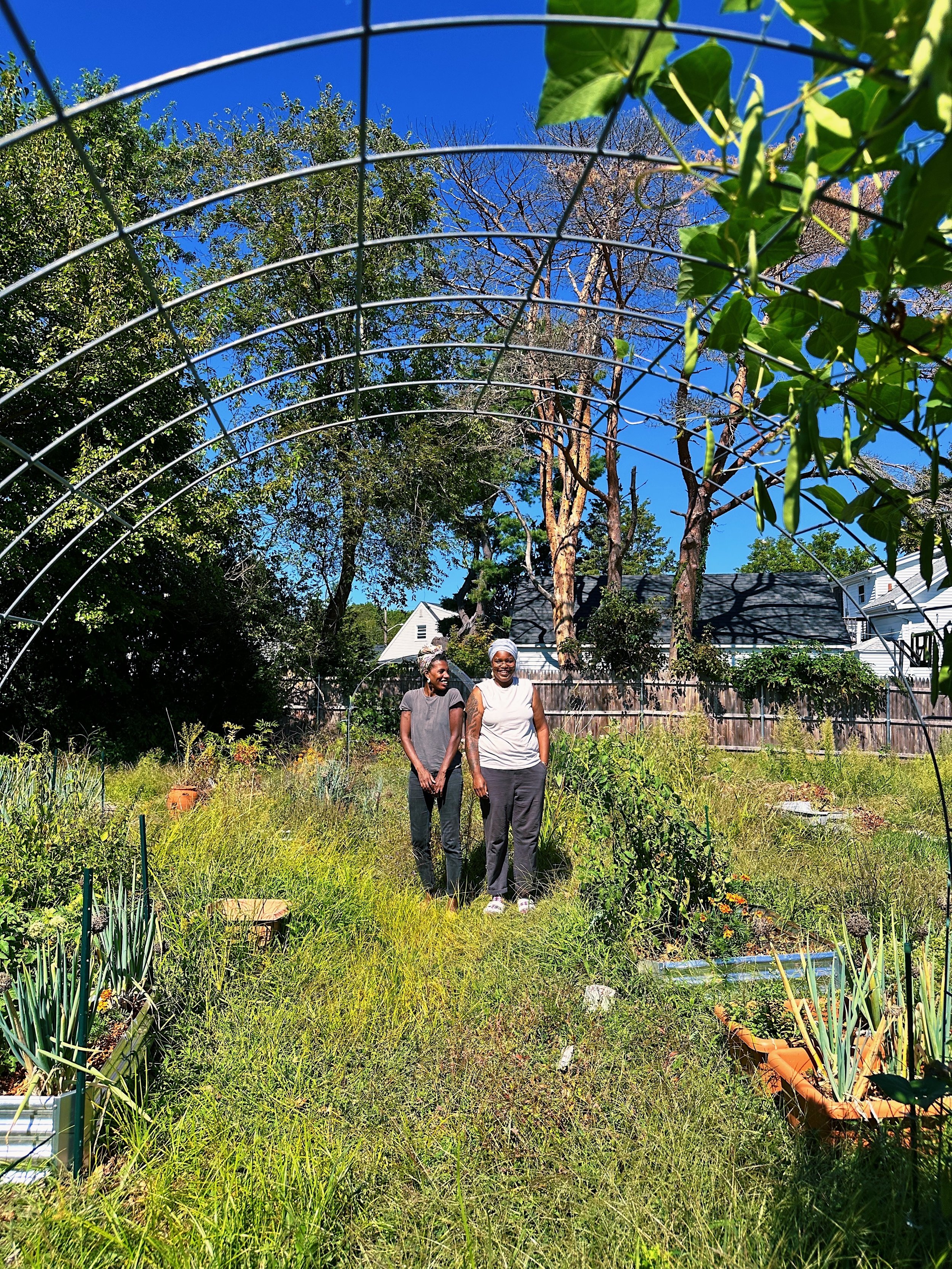
“When Black and Native American people are a part of the record, it’s usually in the shadow of the architectural structures of the South Side, and more as background characters or adornments of the story,” declares artist and culture bearer k. funmilayo aileru, who was born and raised on the South Side of Providence. “I quite literally grew up off of Public Street. At one point, I lived directly on Public Street and Plain Street. Then for most of my childhood, I grew on Prairie Avenue, which is parallel to Public Street.”
“My matrilineal line, we are Narragansett, Niantic people. So Public Street is on Native land, period. When my family came up from South County, that's the area that they moved to. That's the area that my mother grew up in,” aileru says, across from xir partner, artist and designer Edwige Charlot, who nods.
In comparison, Charlot explains, “I needed to cultivate a relationship with [Public Street] because I'm a transplant.” They further describe, “I knew about the community organizing efforts around the Port, the environmental education that's happening with young people, the community gardens. I was aware—I would say like a voyeur, a passive participant in the community—through funmi and through a second degree relationship, not only with the place, but with the people.”
“To enter not only the location, but also how Public Street was also connected to both upper and lower South Side—” (Earlier in our conversations, aileru noted that in xir childhood, there was no distinction: ”All of it was just South Side.”) Charlot continues, “—it just felt like this artery that connected all of these other parts.” Aileru adds, “Based on the chaos.”
░ ▒ ░
Love is at the center of aileru and Charlot’s work. When they invite me to meet with them under the late summer sky, I’m surrounded by their plants. I catch gestures of life partnership between the two: bowls of fruit, sunlit glimpses at the other. They first met in 2018 as colleagues, became friends, and now, they’re partners in more ways than one.
Integral to their artistic and cultural practices is cultivating space for community. Little of this is done in solitude. They are two of the co-founding members of Plantain Press Collective and Blackearth Collective & Lab, collaborate on the Intercultural Beading Circle, and once tended a community plot based on traditional Narragansett plantings at Tooth and Nail Community Support Collective.
It might come as a surprise, then, that their tenure as Artists-in-Residence at Public Street for Providence Commemoration Lab (PCL) is the first time aileru and Charlot are in “intentional creative collaboration” together. This partnership has led to the South Providence People’s Archive, which “is a physical and digital collection of recorded memories and dreams commemorating the Black and Native American residents of the Public Street area – past and present.”
░ ▒ ░
It took conversations with community for South Providence People’s Archive to form. My first full afternoon with aileru and Charlot was as familiar as family, as warm as a welcome back home. It hovered beneath sixty degrees as we observed Indigenous Peoples’ Day at PRONK! 2024 on the dewy lawn of the Met High School. The pair hosted a free pop-up Community Picture Day booth. In research, Charlot noted they did not encounter portraits of “real people,” only those institutions deemed “noteworthy.” Their aim: to intervene against the absence of “everyday, regular, degular life” in archives.
Consent was critical—image was on their terms. Whether in the consent form that community members signed or in the duo's simple request for approval after taking a photo by saying, “Take a look and see if you like it,” the topic of photographic consent came up all day. With PCL photographer Dominique Sindayiganza, we discussed the camera’s potential to thieve a person’s image without permission. But the event wasn’t purely about the picture; it also centered on the community, the first reason for wanting to remember.
Against a light backdrop, families both found and chosen gathered as aileru discussed poses and fitting in the frame, then xi counted down the camera’s shutter. As external lights flashed, the image would appear on a monitor, from which Charlot would edit the image, print the picture, and then tuck it into a custom-branded envelope before handing them to community members. Owing to their background as designers, sleek, consistent project materials continue with aileru and Charlot. The seamlessness allowed them to get to the heart: community.
The duo told me, “Between the conversation and taking of the photograph, we knew we wanted the act of reciprocity present. We also talked to folks about their connection to the South Side as well as the people and places there that are important to them. Those early conversations really helped gain clarity on the direction we should go in with our project.”
In my journal, I wrote aileru’s reflections of Community Picture Day: “doesn’t feel like work,” “it’s replenishing [what] work expels,” and “love between me + edwige.”
░ ▒ ░
Located on the fifth floor of City Hall, the archives for the City of Providence could, in theory, be accessed by anyone who can ascend the half-staircase that leads into the room. There are two reasons one would be found in the City archives: you’re doing business or you’re in legal trouble. The City archive is not the place for hand-kept journals, private stories, and family photos of common people, reminds Traci Picard, a fellow Writer-in-Residence and public historian.
A vast number of the materials here exist in boxes. This includes those on ethnic groups in Providence. Many of these clippings relate to public events and festivals that might have run in a newspaper as a pleasant human interest story. Ethnicity certainly permeates any archive, but here, in a few haphazard selections, the parameters are specified, to be housed in boxes separate from other materials. This specificity, in turn, builds in scarcity.
The most extensive of these ethnic-specific collections is for European Americans. In comparison, the boxes that house materials on both African Americans and Native Americans in Providence are fewer. So few that, in theory, one could walk right out of the room with nearly all of the City of Providence’s dedicated materials on African Americans and Native Americans.
None of this, however, is to suggest that Black and Indigenous residents of Providence have ever lacked a history.
░ ▒ ░
Once aileru and Charlot’s idea for the South Providence People’s Archive (SPPA) cohere, they began to present and table at public events to connect with community members.
In February 2025, they publicly debuted SPPA after an invitation from the City to lead an activity at the fourth workshop for the 246 Prairie Avenue Redevelopment Project. The duo said, “We were invited to host a community activity. We provided artifacts, photographs and printed matter as context”. Against a cornflower blue tablecloth, they invited attendees to write down memories on sheets that read "Remembering Places and Spaces," "Remembering Our Groups and Organizations Past and Present," and "Remembering Our Ancestors and Kin." They also began to offer free digital archiving support services like photogrpahy, printing scanning, and recording with the aim of "preserving the past for our future."
In May 2025, while SPPA tabled at the well-attended Providence Port Day at the JWU Harborside Campus, I met Charlot’s mother. She told me she admired the work that her child and her child’s partner were doing, noting how family keepsakes in Haiti could often be lost due to tropical storms. Later in life, she would eventually move to France, holding on to select items that reminded her of home as “souvenirs.”
Although souvenir has accumulated a touristic connotation, its etymology means that which reminds one of an event, person, place. The implication is distance, suggesting a question: how did one arrive at this distance? For many former Black and Indigenous residents of South Providence, this displacement emerges from city infrastructure. Charlot notes, “You can look at the plethora of parking lots surrounding [Rhode Island Hospital]”, how “Willard Shopping Center basically got rid of the second half of Willard Avenue,” and how “big organizations like the Met School end up consolidating what used to be Public Street.”
░ ▒ ▓ ▒ ░
The SPPA reminds us that people are not replaceable. As aileru notes, “When we were with our aunt [Cheryl Monroe] at her kitchen table doing an archiving appointment, looking at some photographs, allowing her to just take up the space to tell her story from her perspective—it was a really beautiful moment because she also got to tell a Black and Native history that is also an experience of being disabled in a eugenic society, a story that folks want to hide in the broom closet.” Charlot adds, “Or in the basement.”
When I ask Charlot what they will remember from the Lab, they respond, “My intuition about spending the majority of the time building trust and relationship proved to be true. Every engagement, every interaction is demonstrating my values and my commitment to community, to this particular community, and to the people that I've met. Because ultimately, it took a year of connecting with folks and being consistent and showing up and doing more listening than talking, to get to this place where people felt comfortable letting us into their homes, into their space, into their psychological and emotional space, sharing memories with us.”
For now, whether the project will be publicly accessible is unresolved. Charlot observes, “I think it's complicated to have images of Black and Native folks online, because once something is on the Internet, it's not only on the Internet forever, but anyone can do anything with it, right?” The two are committed to a “responsive” archive, noting that the SPPA “is and will continue to be a labor of love.”
I ask aileru what words of advice xi has for other Black and Native youth who are queer and trans who want to make art in the community in which they’re growing up. Xi says, “We're in the 21st century where most people have a smart device. You literally have a camera in your pocket. Number one. Do not rely on cloud storage. Get you some hardware. Number two. Print it.”
Xi offers one last story: “An elder, Valerie Johnson, that we're working with as a young person, learned photography at the Afro Art Center—I might be misquoting. She would go around just taking pictures of the neighborhood. At the time, as a teenager, you're not going to think that most of your neighborhood would be ‘redeveloped’ 30, 40, and 50 years later, when the landscape looks radically different. And then you send some stuff to us fangirling over the photographs that you just took on a walk that you didn't think anything of. What's ordinary to you might be extraordinary to somebody else.”